
When you are facing a mountain of credit card debt, many people get confused and overwhelmed with all of the information that is out there to "help". Over the last year or so, we added many posts to this blog about various options for Credit Card Debt Elimination.
I thought it might be helpful to pull together what I find to be the most helpful posts on your best 3 Credit Card Debt Elimination Options:
#1 If you can keep up with your current payments, you should try to eliminate your debt with a Debt Snowball. Click on the link below to read a post about what a Debt Snowball is and how to use it.
#2 If you have fallen behind on your debts, but would be able to keep up with your payments if you could just get caught up, Debt Consolidation may be your best Deb Elimination option! A Debt Consolidation program can help reduce your monthly payments, lower the interest rate your credit card companies are charging, and put you on a "level payment plan" to get you out of debt FAST! Click on the link below to read a post all about what a Debt Consolidation program can do for you.
#3 If you have had a drastic change to your monthly finances (loss of job, divorce, illness...) or if you are behind on your credit card or other unsecured debt payments by more than a couple of months, Debt Settlement is probably going to be your best option. Click on the link below to learn about Debt settlement and how it can help you reduce your monthly payment, get rid of interest and fees altogether, and eliminate your debt for HALF of what you owe!
If you still have questions about the options available to you, or if you want to find out how to get started with these programs, our Debt Solution Specialists can help. Feel free to ask a question in the comment thread below, call our toll-free number, or click on the button at the bottom of the page for a FREE DEBT ANALYSIS! We are here to help find the right solution for your situation.
1-877-492-4109


Does reading your credit report make you feel like this?

Getting a copy of your credit report is simple to do right from your home computer using AnnualCreditReport.com. When you have your credit report, you'll be able to see what your creditors are saying about you. However, credit reports can be a little confusing and very intimidating. In this post, you'll find a step-by-step explanation of how to read and interpret your credit report.
Section One: Your Personal Information
Here you'll find identifying information like your:
- name
- current address
- social security number
- date of birth
- spouse's name (if applicable)
Don't just skim over this section. Make sure everything is correct. One bad piece of information and the credit history listed on your report could be wrong.
Section Two: Credit History
The Credit History section contains a list of your open and paid credit accounts and indicates any late payments reported by your creditors. It is extremely important to read through this section very thoroughly. If you find any information that is incorrect or accounts that don't belong to you, you'll need to submit a dispute letter to the credit-reporting agency.
- Company Name - identifies the company that is reporting the information.
- Account Number - lists your account number with the company.
- Whose Account - Indicates who is responsible for the account and the type of participation you have with the account. Abbreviations may vary depending on the reporting agency but here are some of the most common:
- I - Individual
- U - Un-designated
- J - Joint
- A - Authorized User
- M - Maker
- T - Terminated
- C - Co-maker/Co-signer
- S - Shared
- Date Opened - This is the month and year you opened the account with the credit grantor.
- Months Reviewed - Lists the number of months the account history has been reported.
- Last Activity - Indicates the date of the last activity on the account. This may be the date of your last payment or last charge.
- High Credit - Represents the highest amount charged or the credit limit. If the account is an installment loan, the original loan amount will be listed.
- Terms - For installment loans, the number of installments may be listed or the amount of the monthly payments. For revolving accounts, this column is often left blank.
- Balance - Indicates the amount owed on the account at the time it was reported.
- Past Due - This column lists any amount past due at the time the information was reported.
- Status - A combination of letters and numbers are used to indicate the type of account of the timeliness of payment. Abbreviations for the type of account are as follows:
- O - Open
- R - Revolving
- I - Installment
- Date Reported - Indicates the last time information on this account was updated by your creditor.
Section Three: Collection Accounts
If you have accounts that have been referred to collection agencies in the last seven years, this is where they will be reported. The name of the collection agency will be listed along with the amount you owe and, in some cases, their contact information. If a collection is listed on your report that doesn't look familiar to you, contact the credit bureau and submit a dispute letter.
Section Four: Public Records
Here you'll find a listing of public record items that reflect your history of meeting financial obligations. Such as:
- Bankruptcy records
- Tax liens
- Judgments
- Collection accounts
- Overdue child support
Look closely at all the information listed here. If anything is mistaken, contact the credit bureau and submit a dispute letter.
Section Five: Additional Information
This section consists primarily of former addresses and past employers as reported by your creditors.
Section Six: Inquiries
Contains a list of the businesses that have received your credit report in the last 24 months. If you find the names of businesses that sound unfamiliar, you should find out who they are and why they're looking at your credit! The credit-reporting agency may be able to help you with contact information.
If you find out that you have more debt that you thought and need help ELIMINATING YOUR DEBT once and for all, our Debt Solutions Specialist can help you find the right program to fit your goals. Click the link below to get a FREE Debt Summary based on your debt and start heading towards becoming debt free today!
photo by: Kay Kim

If you have accumulated a substantial amount of unsecured credit card debt, you may be tempted to try Do It Yourself Debt Settlement.
Although it is possible, most people who are inexperienced in dealing with debt collectors end up paying much more than they should.
Why does Do It yourself Debt Settlement end up costing you more?
There are several reasons, but the most important is that debt collectors are for the most part, TRAINED PROFESSIONALS whose only job is to get as much money out of you as possible!
They don't care about your circumstances or why you have fallen behind, and since most of them are paid on commission, they can get mean when trying to get you to pay up.
Collection agencies and Law firms that deal with collections will throw around terms like:
- LEGAL ACTION
- LAWSUIT
- WAGE GARNISHMENT
- LEVY
This scares the average person into agreeing to a monthly payment plan they can't afford or a settlement for 75%-80% of the balance. A reputable Debt Settlement agency knows how to deal with these collectors and how to get you the best deal possible.
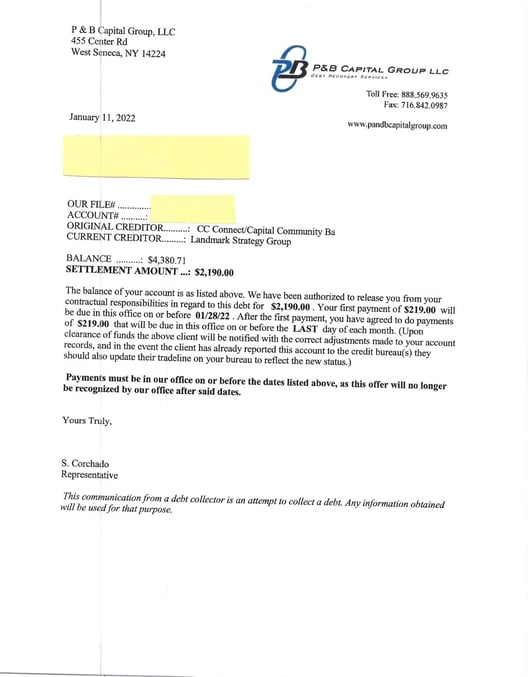
Here is a real life example of a settlement that was just completed by our Settlement Specialists:
Our client was a single female and was unemployed for a long period of time. As a last resort, she used her credit cards to buy groceries, gasoline, and sometimes cash advances to pay her rent.
One of her cards was a Visa Card and after charge-off was given to a collection agency. After several unsuccessful attempts to "work something out" with the collection agency, she contacted us to find out what her Debt Relief Options were.
She decided that Debt Settlement was her best option, and our Debt Settlement specialists went to work!
The original balance was approximately $1,400, but after moving around from collector to collector , it was purchased by a "LAW FIRM".
The balance had grown to more than $2,500 as over $1,100 had been added in interest, late fees, and so-called legal fees.
After going back and forth with the collector, our Debt settlement Specialists were able to negotiate the debt down to just $700 which was 50% of the original amount but only 28% of the RIDICULOUSLY INFLATED current balance.
Click Here to See the Actual Settlement Letter
Yes, it is possible for you to negotiate settlements on your own, but after 10 years of experience in helping hundreds of clients settle debts, avoid garnishment and bankruptcy, I believe in the long run the average person will end up paying much more than necessary.
If you need help settling your debts, our Debt Solutions Specialist are here to help.
1-877-492-4109
Or simply click on the link below for a Free Debt Elimination Analysis!

If you have fallen behind on your credit card payments, you know just how annoying the debt collector calls can be. Some people are so bothered by their creditors ongoing calls that they change their phone number or even disconnect their phone to get some peace and quiet. Although those are good options, they really only need to be uses as a very last resort.
A little education can go a long way. Here is what you need to know to stop those collection calls once and for all!
When Can Debt Collectors Call?
The Fair Debt Collection Practices Act (FDCPA) is the Federal law that says what debt collectors can and can't do. They aren't to call you about a debt that you don't owe. When you are first contacted by a collection agency, you have the right to request them to verify the debt is yours. If the debt collector can't come back with proof that you owe the debt, they're not allowed to contact you anymore.
Even without sending a validation request, debt collectors have certain rules they must follow when it comes to contacting you over the phone. They can't call you before 8 a.m. or after 9 p.m. your local time. They can't call you repeatedly, and they can't call you at anytime you've previously stated is inconvenient.
Stop Debt Collection Calls
All you have to do to stop debt collectors from calling you is tell them that you prefer to communicate with them in writing. Written communication works in your favor because it gives you a record of everything that is said. If the debt collector violate the FDCPA, you have written proof of that violation. Keep in mind that, by law, the debt collector does not have to honor this request.
If the debt collector does not honor your request to communicate with you in writing, the next best way to stop debt collectors from calling you is by sending what is known as a cease and desist letter. In the letter, state that the collector should cease and desist further communication with you. Note that the cease and desist letter only applies to debt collectors, not the original creditor.
What Happens After you send the Cease and Desist?
Once the collection agency receives your cease and desist letter they can communicate with you once more, via mail, letting you know one of three things.
- further efforts to collect the debt are terminated
- Certain actions may be taken by the debt collector
- The debt collector is definitely going to take certain actions.
When you send the cease and desist letter to the debt collector, send it via certified mail with return receipt requested. This will provide proof that the letter was sent and received. If the debt collector communicates with you beyond the single instance allowed by law, this evidence will allow you to seek punitive action against the debt collector.

photo by: stevendepolo
There is a way to STOP WAGE GARNISHMENT, but it is easier to prevent than to stop!
Most states allow a creditor who has been awarded a judgment concerning a debt owed to apply for a writ of garnishment that would allow them to garnish up to 25% of your net income.
This would be devestating!
We get many calls asking us to help AFTER THE FACT, and although we often can and do stop wage garnishment, it is not easy. Before we share a couple of ideas or techniques to try, it is important that you understand the process of a wage garnishment:
When you don't pay the debt you owe (and for the purpose of this article, let's talk about a basic unsecured credit card), the creditor starts contacting you with letters and phone calls.
They can be very annoying and in some cases the creditors will violate the Fair Debt Collection Practice Act (FDCPA). You can STOP the CALLS , but for now, let's talk about stopping wage garnishemnt.
If the creditor cannot get you to start paying back the debt, they may choose to file a COMPLAINT in your local county courthouse.You will receive a SUMMONS, usually hand delivered, that states that you owe the debt and have 20-30 days to respond with an ANSWER to the court.
The "ANSWER" would be your legal (has to be filed correctly and there usually is a fee) explanation why you dispute the "CLAIM" and don't owe the debt. For 99% of those who receive a SUMMONS, they owe the debt (even though the interest and late charges added are ridiculous!), so disputing the claim is usually a waste of time and money.
At this point, YOU CANNOT IGNORE THE SUMMONS!!!!!
If you have some money set aside, call the creditor or attorney and offer a SETTLEMENT or arrange to repay the debt in monthly installments (called a STIPULATED AGREEMENT).
A SETTLEMENT is an offer to settle the debt you owe for less than the full amount. A creditor may accept an offer of 50%-75% if you can make it in a lump sum or possibly in 3 payments.
A STIPULATED AGREEMENT is really just an agreement between you and the creditor/attorney to repay all of the debt at a reasonable monthly payment at a state limited interest rate. As long as you don't miss any payments, they agree to not pursue the wage garnishment.
Since they have the JUDGMENT, and know you are employed, they are guaranteed to receive 100% of the debt owed plus filing fees and court costs, so you are not in a very strong negotiating position.
If trying to Stop Wage Garnishment on our own sounds intimidating, you may need HELP!
For a FREE ANALYSIS OF YOUR OPTIONS, contact one of our Debt Solutions Specialists at 1-877-492-4109 OR simply click the link below.
photo by: purpleapple428
Choosing to enroll in a Debt Settlement program with Debt Relief NW or any other company can be a tough decision. Every day we get asked some of the same questions over and over again about the Debt Settlement program.
Below I have answered the top 5 most common Debt Settlement question to help you in making this important and life changing decision.
When will Debt Relief start negotiating my debts?
Once you have enrolled in the program, your creditors will be notified, and the process will begin. Your debts will be resolved as funds become available through your savings plan.
Will my creditors continue to contact me?
The original creditor retains the right to contact you, until such time as the debt has been transferred to a 3rd party for collection efforts. Because you may still receive phone calls from the creditors, we will provide you with the tools you need to handle those calls. Your creditors can also contact you by mail. If you have questions regarding any correspondence you receive, you should immediately contact your Solutions Specialist. They will handle all of your creditors and collectors on your behalf. 
Do all of my creditors have to be included in the Debt Settlement program?
No. We will handle only those debts that you want to include in the program. Many people retain one credit account for emergency use. Discuss your situation with your Solutions Specialist.
How long will my Debt Settlement program last?
This depends upon the amount you can save monthly and how much debt you are have. At Debt Relief, we offer programs that can fit within any budget and can eliminate your debt in as little as 18 months. However, we will work with you to create a program that specifically address your needs and objectives.
Will I be able to get credit in the future?
Yes. When you have successfully finished the program, the debt you placed in our program will have a zero balance. Good cash flow and the ability to pay are what lenders look for. Clients are able to purchase homes, refinance and obtain credit cards, and re-establish their good credit rating.
Only you can know what is the best decision for you and your family. However, our Debt Solutions Specialist are here to answer all of your questions and help you decide if Debt Settlement is your best option or if there is another program that would work better for you.
Please submit your questions in the comments section below or simply give us a call!
1-877-492-4109

When preparing tax returns, we all try to find as many legal deductions as possible. But, figuring out just what you can deduct can be tricky. One question we get here all the time is, "Can I deduct credit card interest?"
The answer is not just a simple yes or now, but it is SOMETIMES. Let me elaborate.
According to the Internal Revenue Service (IRS), personal interest, such as interest paid to a credit card company, is NOT deductible. However, it the credit card in question is uses for business or self-employment expenses, you can deduct some or sometimes even all of the interest paid to that credit card company using a Schedule C or Schedule C-EZ.
Here is what you need to do in order to Deduct Credit Card Interest on your taxes:
Step 1: Use your credit card for business, or self-employment expenses. (You may use the card for both business and personal expenses, but you can only deduct interest on charges made for business or self-employment expenses.)
Step 2: Figure out what percentage of of your credit card balance is from business spending. (If your total balance is $4000 and only $3000 is from business expenditures, devide $3000 byt the total balance of $4000 and you will find that your business expenses make up 75% or 0.75 of your total balance)
Step 3: Figure out how much interest you can deduct. Multiply your total interest payments by the percentage of your expenditures that were for business or self-employment. (in this case, 75%) This is the total interest you can deduct.
Step 4: When filling out your Schedule C, enter your deductible interest (figured out in step 3) in line 16b. Complete the rest of the form and file your taxes as normal.
This is a pretty simple proccess, but if you have questions or are not sure if you are figuring correctly, always consult a licensed tax preparer.
If you find that you have paid more that you thought in credit card interest, there are Debt Consolidation and Debt Settlement programs available that can help you reduce or even eliminate the amount of interest you are paying. Our Debt Solutions Specilists can help you find the right program for your unique situation.
Please give us a call for a FREE DEBT CONSULTATION at 1-877-492-4109
Or simply click on the link below
photo by: DonkeyHotey
When you are searching the BEST DEBT SETTLEMENT COMPANIES, here are 3 questions to keep in mind -->
#1 Do they have a good rating with the Better Business Bureau?
- Look for companies that have a Better Business Bureau (BBB) rating of B+ or higher. It takes a lot of work for a company to receive and maintain a high rating with the BBB.
- Watch out for complaints and DO NOT DEAL with a Debt Settlement company that has a long list of complaints!
- Don't worry about accreditation. The BBB is a network of private companies that make money rating companies. They offer an "accreditation" to companies for a large annual fee in order to make more money. whether or not a company is accredited is not the issue.
#2 Can you call the Debt Settlement company and talk to someone?
When you call in to a good Debt Settlement Company, you should be able to talk to a live person that will listen to you and work with you to find the best solution possible.
- Can you understand them?
- Do they make you feel comfortable
- Are they listening to you or are they just trying to talk you into what they are offering?
A quality company seeks to find the right solution for your specific needs and debt settlement is not always the best fit!
#3 Does the Debt Settlement company's website give you plenty of information that without forcing you to "complete the form"?
Quality Debt Settlement Companies will provide a lot of information...FOR FREE, without enrolling in their program. Look for a company website that is informative, educational, and easy to understand. You should be able to know what the company is about and what they have to offer before you give out your contact information.
Want to know if Debt Settlement is the best option for you? Click on the link below or call
1-877-492-4109
to talk to one of our Debt Solutions Specialists.

If you are just starting to build your credit or if you have bad credit history and are trying to re-build, a Secured Credit Card can help.
What is a Secured Credit Card?
A secured card requires you to put down a cash deposit that will become the credit line for that account. For example, if you put down a $300 deposit; you can charge up to $300. You can add to the deposit in the future to add more credit. However, sometimes a bank will reward you for good payment history and add to your credit line without requesting additional deposits.
Where can you get a Secured Credit Card?
Most large banks and almost all credit unions have secured credit cards available to their customers. Check with your bank or credit union first to find out what kinds of secured credit cards they offer and what fees and interest rates are associated with them.
If your bank or credit union does not offer Secured Credit Cards, you can check this list of Secured Credit Card Companies.
What’s the Catch?
As with any financial decision you make, you need to do your research and read ALL of the fine print. There are great companies out there that charge low fees and will treat you well. But watch out for the few really bad companies out there! There are some that will give you a Secured Credit Card, but require you to pay for an account insurance policy for $50 each month.
The FTC has organized a crackdown on companies like this, but you still want to be careful. Gather plenty of information before you apply for a card.
What is the Best Way to Use Your Secured Credit Card to Build Your Credit?
Use your new Secured Credit Card to make a few small purchases each month, but NEVER charge more that you can pay off in full! This is not the kind of card that you want to use to carry a balance. By making purchases and paying off the balance each month, you will prove your credit worthiness and quickly build your credit!

Earlier this week, in the post Money Makeover for the New Year - Part 1, I talked about the first four steps toward making positive changes to help you achieve financial fitness in the New Year:
Step 1: Set Your Financial Goals
Step 2: Live Within Your Means
Step 3: Stop Using Your Credit Cards
Step 4: Keep and Eye on Your Credit Report
Today I will finish up this two part series with the final 4 steps of your Money Makeover:
Money Makeover for the New Year - Part 2
Step 5: Creat an Emergency Fund
When life throws an unexpected event at you, and we all know this will happey, having an emergency fund can make all the difference. Make a committment to save 5% of your income for the first 3 months. Then bump that up to 10% for the next 3 months. By the end of the year, saving will become a habit and you will have begun to build a sizable emergency fund.
To help make this savings plan automatic and "pain-free", set up and automatic transfer of funds from your checking to your savings account after each pay day. Breaking up your savings over them month will seem easier than coming up with the whole ammount at once.
Step 6: Always Pay More than the Minimum Payment
I can't stress this enough, so I will repeat it...ALWAYS PAY MORE THAN THE MINIMUM PAYMENT! Even if you can only add $5 or round your payment up to the nearest even number. Every extra dollar you pay will help you eliminate your debt faster and save you thousands on interest over the life of your debt.
Step 7: Contribute to Your Employers Retirement Plan
Most employers will match your contribution into the companies retirement plan such as a 401K. Not only are your preparing for your future, you are getting FREE MONEY from your employer! If you are self-employed or if your employer does not offer a retirement plan, you can invest in an Individual IRA, Roth IRA, and/or plan for self-employed persons.
Step 8: Don't Hesitate to Ask for Help if You Need It!
After you have taken a close look at your budget and your overall financial situation, you may feel like eliminating your debt is never going to happen. This couldn't be further from the truth. You have several great debt relief options available to you.
If you have made financial New Year's resolutions in years past without success, don't give up! Try again using these 8 steps to a Money Makeover to build new habits and provide a better financial future for you and your family.